



20 July 2026
Social Impact Credits Start With Three Conditions. We’re Working on Designing for All Three
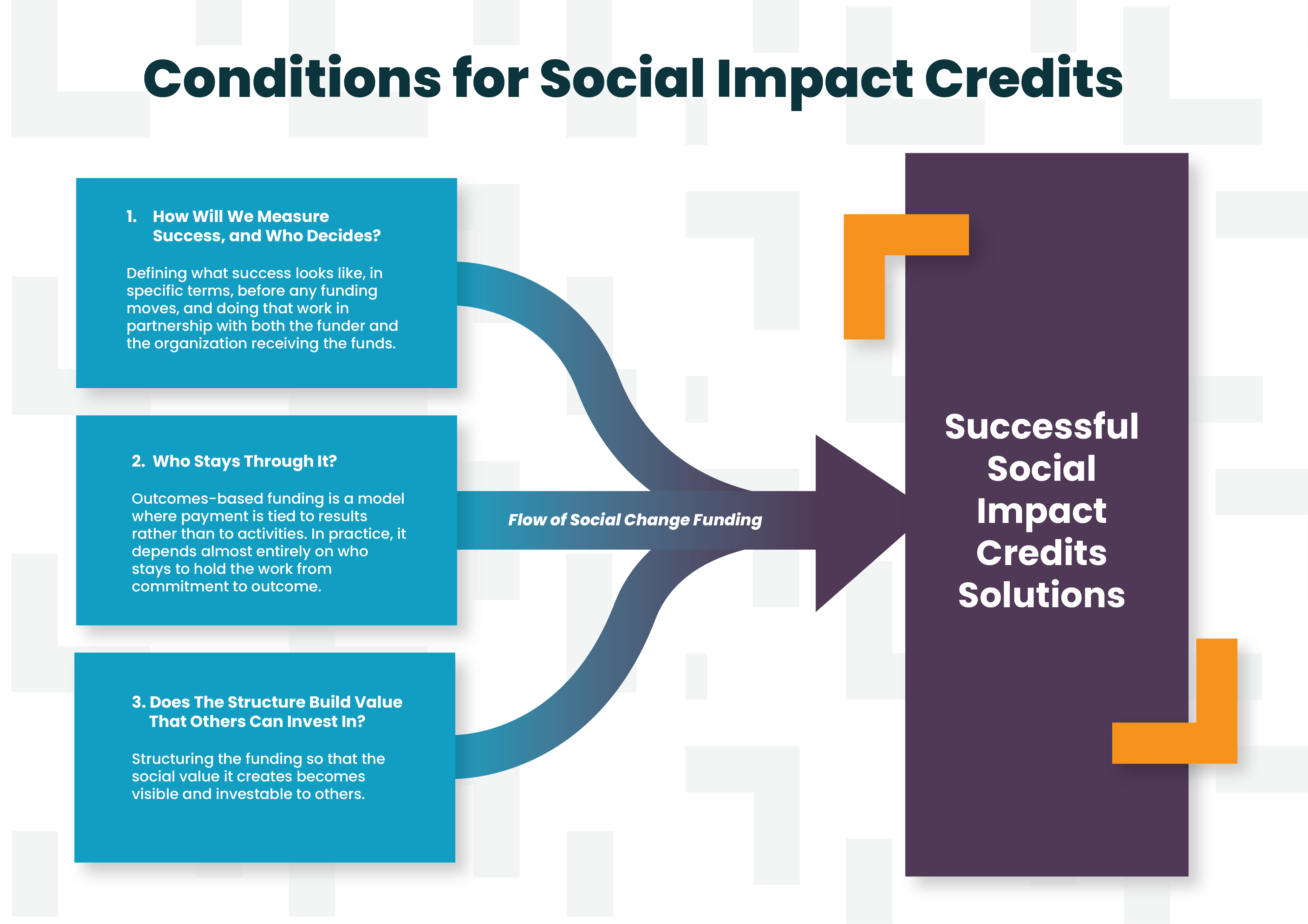
Urban Matters is exploring the development of Social Impact Credits, a model that would pay for verified, place-based social outcomes and convert those outcomes into financial assets. South Korea’s SK Group has been running this approach since 2015 and has documented more than $363 million in social performance value. What makes it work, anywhere, comes down to three conditions most alternative funding conversations skip: co-defined success before any money moves, a trusted intermediary who stays through implementation, and a structure that builds value others can invest in.
The Implementation Gap in Social Change Funding
Communities across Canada have more tools for funding social change than at any point in recent memory. Community bonds, social impact bonds, outcomes-based contracts, public-private partnerships, the options have expanded considerably, and funders and governments are more willing to use them than they were a decade ago. That’s real progress, and it matters.
What hasn’t grown at the same rate is our ability to close the implementation gap, to move from intention to action after the structure is in place. The dollars and the intentions, on paper, can look nearly identical. The outcomes rarely are.
Social Impact Credits as a Potential Solution
Social Impact Credits are being designed to address this. The model draws on carbon market logic: instead of paying to reduce emissions and trading the credits, you pay for verified social outcomes, housing stability, employment, improved health, and those verified outcomes become financial assets that companies and governments can hold as part of their impact portfolios. The World Economic Forum’s 2025 report on tradeable impact identifies South Korea’s SK Group, running this approach since 2015, as one of the most developed examples globally, with more than $363 million in documented social performance value and $52 million paid directly to social enterprises delivering the outcomes.
The question we keep coming back to is: what would a Canadian version look like, built around the specific outcomes that matter most in a given community, and designed with all three conditions in from the start rather than discovered one project at a time? After working with communities across BC on alternative funding structures, and spending the last year thinking through this model, we’ve landed on three conditions that consistently separate the approaches that stick from the ones that stall.
Condition 1: Defining How We Will Measure Success, and Who Decides it

The first condition sounds obvious until you see how often it gets skipped: defining what success looks like, in specific terms, before any funding moves, and doing that work in partnership with both the funder and the organization receiving the funds.
This is about measurement and evaluation, and it’s about who is in the room when the targets get set. Too often, funded organizations are handed outcome requirements defined by the funder after the relationship begins, tied to activities rather than to real changes in people’s lives, and built around data the funded organization was never resourced to collect. That creates a dynamic where everyone is reporting against numbers they didn’t shape and can’t meaningfully track. The model gets blamed for not working when the problem was there from the start: no one co-created the definition of success.
How Gibsons, BC Defined Value Before Anyone Asked
The Town of Gibsons, BC offers an inspiring example of how this thinking can open new doors. Facing a $4.9 million water treatment infrastructure bill with no debt room to pay for it, the town did something most municipalities don’t: they formally placed a dollar value on their natural aquifer, the underground water source that supplies most of the town’s drinking water, and listed it on the municipal balance sheet alongside roads and buildings. By recognizing the aquifer as a capital asset with a real replacement cost, the town became eligible for grants and alternative financing structures that a conventional infrastructure project wouldn’t qualify for, and the $4.9 million project was deferred entirely. More than 60 Canadian municipalities have since adopted the approach through the Municipal Natural Assets Initiative.
The town defined the value in partnership with planners, engineers, and the community before any funder was involved. That sequence matters.
The Same Principle Applies to Social Outcomes
The Gibsons example is ultimately about naming the value of something before it’s at risk, and doing that work before money moves. The same principle applies directly to social outcomes. Define what matters, establish who will assess it independently, and co-create the evaluation with the people doing the work, not just the people writing the cheques.
The most important conversation in any funded initiative happens before the funding is confirmed. Who defines success, and with whom, shapes everything that follows.
Condition 2: Identify Who Needs to Stay Through It All

Outcomes-based funding is a model where payment is tied to results rather than to activities. Instead of paying an organization to run a program, a funder agrees to pay when specific, independently verified outcomes are achieved, like fewer people in shelter, more children in stable homes, or improved health over time. The organization delivers the work, a third party verifies that the results actually happened, and the funder pays based on what changed. It’s a sounder model than activity-based funding in theory, and the evidence from places that have implemented it well is compelling.
In practice, it depends almost entirely on who stays to hold the work from commitment to outcome.
The Denver Supportive Housing Initiative
The Denver Supportive Housing initiative is one of the most closely studied examples in North America. In 2016, private investors and philanthropic funders paid upfront for housing and case management for 250 people experiencing chronic homelessness in Denver, each cycling through emergency rooms, jails, shelters, and detox at a cost to the city of more than $15,000 per person per year. The City of Denver would repay investors only once an independent team confirmed the results through a structured evaluation. After one year: 86% of participants were stably housed, shelter visits dropped 40%, arrests dropped 40%, jail days dropped 27%, and the city offset roughly half its program costs through reduced emergency spending. The Colorado Coalition for the Homeless and the Mental Health Center of Denver didn’t just fund this work. They stayed with it.
Restoring the Sacred Bond, Manitoba
Closer to home, Manitoba ran a version of the same model with Restoring the Sacred Bond, the province’s first social impact bond, led by the Southern First Nations Network of Care and Wiijii’idiwag Ikwewag. Eight investors, including the McConnell Foundation, Inspirit Foundation, and the Children’s Aid Foundation of Canada, put up $2.6 million to fund something governments consistently underfund: prevention. The program matched Indigenous birth helpers with Indigenous mothers at risk of having their newborns apprehended, pairing them with someone from their own nation who could offer culturally grounded support before, during, and for a full year after birth. Manitoba agreed to repay investors only once an independent evaluator confirmed reductions in the number of days children spent in care, with returns of 4.1% for meeting targets and 5.5% for exceeding them. A published evaluation has not yet been released publicly, but the design principle is the one that matters: the province only pays if the outcomes actually happen, and the people delivering the work are accountable to their own communities, not just a contract.
What Made Both Approaches Work
Both initiatives work for the same reason: a trusted intermediary with deep community roots stayed through the full arc of implementation, and the funding model held everyone accountable to outcomes rather than effort.
Condition 3: Creating a Structure That Builds Value That Others Can Invest In

The third condition is the one that keeps a single project from staying a single project: structuring the funding so that the social value it creates becomes visible and investable to others.
The Toronto Social Bond Program
Toronto did this when it became the first municipality in Canada to issue a social bond, a bond tied directly to specific social outcomes including affordable housing, shelter, and neighbourhood investment. The first issuance raised $100 million in 2020. By October 2024 the city had issued $850 million across five issuances, funding capital repairs across 43,000 Toronto Community Housing units that house more than 90,000 residents, shelter infrastructure, and the George Street Revitalization project. In 2024 alone, 380 clients from Seaton House moved into permanent housing, and 176 Indigenous households transitioned to stable housing through the program. The program won Social Bond of the Year at the Environmental Finance Bond Awards in both 2021 and 2022. Other mission-aligned investors came back because the structure gave them something to hold, not just something to support: transparent criteria, independent reporting, and a track record.
Why the Structure Matters Beyond One Project
That is what shifts an ecosystem rather than just a project. When social value becomes something an investor can return to, it stops depending entirely on the generosity of any single funder.
What It Looks Like When All Three Are Designed In
What Each Example Contributed
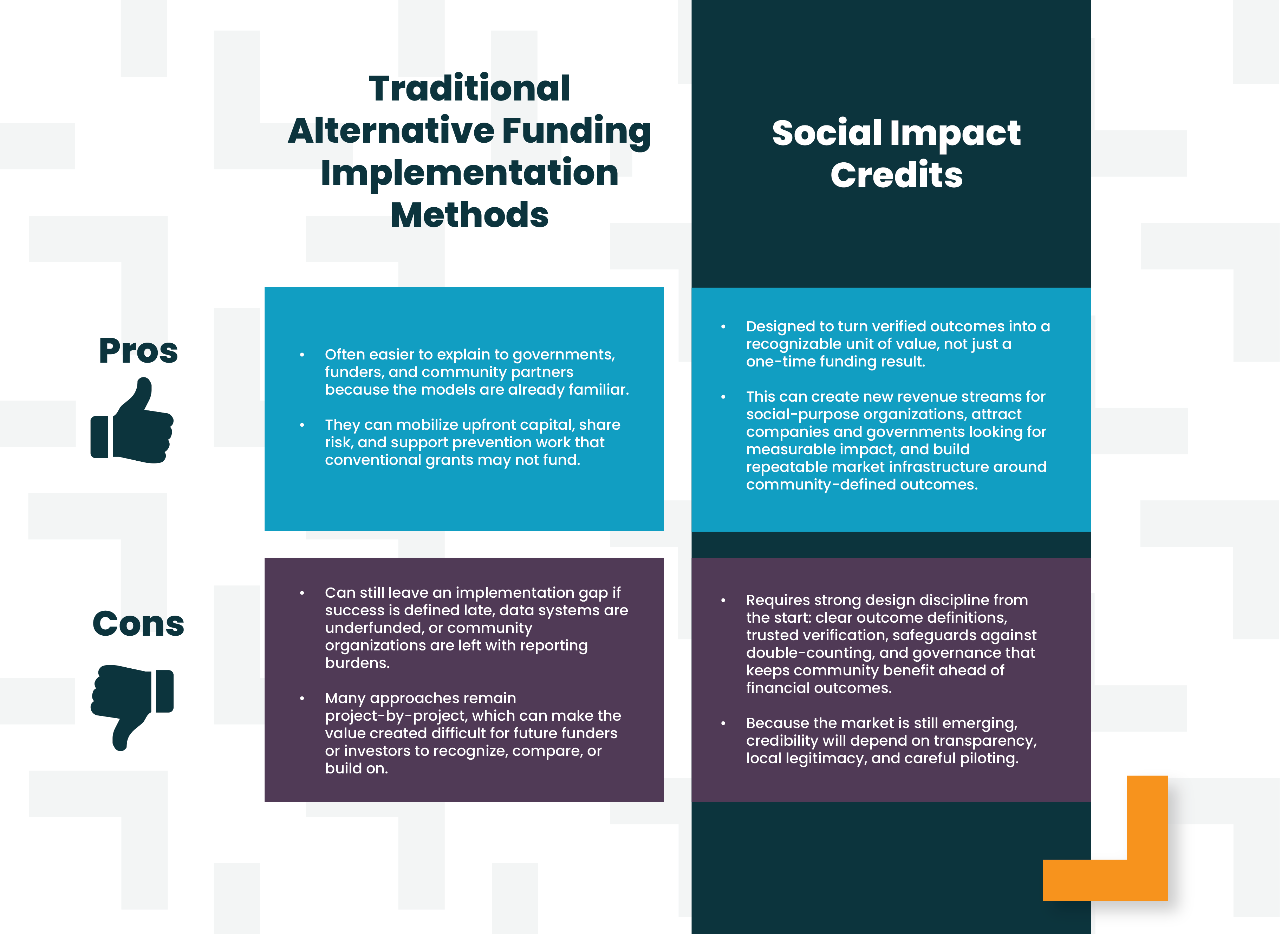
Each of the examples above made a real contribution to what communities across Canada can draw from. Gibsons showed how co-created measurement can open doors that a conventional infrastructure project never would, and more than 60 municipalities have followed with the natural assets approach since. Denver and Restoring the Sacred Bond showed what’s possible when a trusted intermediary stays through the full arc of implementation, and the funding model holds everyone accountable to outcomes rather than effort. Toronto showed that social value can become something an investor returns to, not just something they support once.
Designing for All Three from the Start
The harder work, and the opportunity, is building something that starts with all three conditions rather than arriving at each through separate projects over many years. That’s what we’re working on with Social Impact Credits, starting with specific, place-based outcomes that communities define as their highest priority. We’re in early exploration, and we think the model takes better shape if the funders, governments, and community organizations who would participate help design it. If you’re working in this space and curious about what we’re exploring, we’d welcome the conversation.
Interested in What a Canadian Version Could Look Like?
If you’re working in community investment, philanthropy, or ESG and thinking about how alternative funding models could work differently, or if you’re curious about Social Impact Credits and what a Canadian pilot could look like, we’d like to hear from you.
Get in touch: erin.welk@urbanmatters.ca
Start a conversation with Urban Matters
Frequently Asked Questions
Outcomes-based funding is a model where payment is tied to results rather than to activities. A funder agrees to pay when specific, independently verified outcomes are achieved, like reduced shelter use, improved housing stability, or better health outcomes, rather than simply for running a program. A third party verifies the results before payment is made. It works best when the outcomes are co-defined with the organization doing the work.
A social impact bond is a type of outcomes-based contract where private or philanthropic investors provide upfront capital for a program, and a government or funder agrees to repay them only if independently verified outcomes are achieved. If the program doesn’t deliver, investors absorb the loss. Manitoba’s Restoring the Sacred Bond and the Denver Supportive Housing initiative are two of the most well-documented examples in North America.
Social impact credits are verified social outcomes that have been converted into financial assets. Drawing on the structure of carbon markets, the model identifies specific positive outcomes, like housing stability or employment, verifies them through an independent third party, and converts those verified outcomes so that companies and governments can hold or transfer them as part of their impact portfolios. South Korea’s SK Group has been operating a version of this model since 2015, documenting more than $363 million in social performance value.
Co-creating evaluation means that the targets used to assess success are developed jointly by the funder and the funded organization, not handed down after the relationship is established. It means the organization delivering the work has meaningful input into what gets measured, how, and by whom, and is resourced to collect the data. Targets set without the people doing the work tend to measure the wrong things, or the right things badly.
Sources
- Restoring the Sacred Bond — Manitoba Social Innovation Office
- Denver Supportive Housing Social Impact Bond — Colorado Coalition for the Homeless
- City of Toronto Social Debenture Program
- Town of Gibsons Natural Asset Management Journey
- WEF: Redefining Value — From Outcome-Based Funding to Tradeable Impact (2025)
Categories:
Social Finance


